

Parallel operation technology of inverters
The rapid development of modern information technology has put higher and higher requirements on the capacity, performance and reliability of household or commercial power supply systems, and has also promoted the continuous deepening of the research on power electronics technology and the continuous expansion of the research field. The realization of large-capacity power supply by connecting multiple modules in parallel is recognized as one of the important directions for the development of power conversion technology today. Multiple power modules are connected in parallel to share the load power, and the current stress of the main switch devices in each module is greatly reduced, which fundamentally improves reliability and reduces costs. At the same time, the power capacity of each module is reduced, which greatly increases the power density. In addition, multiple modules are connected in parallel to flexibly form various power capacities, replacing serialization with modularization, thereby shortening the development and production cycle and reducing costs, and improving the standardization, maintainability and interchangeability of various switching power supplies.

The current development trend of large-capacity inverter power supplies is to use fully controlled high-frequency switching devices to form inverter power module units and then expand the capacity by connecting multiple modules in parallel. Research shows that the use of N+1 redundant parallel connection is a good solution.
The main advantages of the parallel solar hybrid inverter are as follows:
It is convenient to increase the capacity of the system
Redundancy can be achieved through parallel connection to improve reliability
The maintainability of the system can be improved
It is easy to achieve modularization and standardization

The following is the equivalent circuit diagram of two parallel inverters. Among them, U, U, are the fundamental components of the output PWM wave of the inverter bridge; Uu, is the output voltage of the inverter power supply; r, r, are the equivalent impedances that characterize the inverter power supply loss factors such as the inductor internal resistance line impedance; r, r, are the line impedance of the parallel line; L, L,, C, C, are the filter inductance and capacitance of the inverter power supply; Z is the common load of the two inverter power supplies, which can be inductive, capacitive or purely resistive.
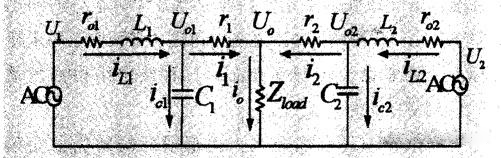
Since the inductor current lags the voltage by 90°, the circulating current at this time is mainly the reactive component. When U l and u 2 only have a phase difference, this voltage difference leads the inverter output voltage by 90°, and the circulating current is in phase with the inverter voltage. Therefore, the circulating current at this time is mainly active.
Due to the existence of the circulating current i H , the output current of each inverter power supply not only contains the effective load current component, but also the circulating current component. Under different conditions, the circulating current component presents different load characteristics relative to each inverter power supply, either active or reactive. The circulating current component changes the output current of each inverter power supply and also changes the output power of each inverter power supply accordingly, making the load borne by each inverter power supply unbalanced.
From the above analysis, it can be concluded that to realize the parallel connection of inverter power supplies, it is necessary to ensure that the amplitude, frequency, and phase of the output voltage of each inverter are consistent, and to ensure that each module divides the active and reactive currents according to the preset ratio, so that the output circulating current is equal to 0.